The Digital Volkswagen Campervan!
The Digital Volkswagen Campervan!
Get ready to step into the future with the innovative new digitalised Volkswagen California!
Updated 2nd July 2019; original article posted 22nd February 2019
Hanover, 2 July 2019 — Volkswagen Commercial Vehicles has revealed the first sketches and details of the new California 6.1. This Campervan update covers many aspects: the multifunctional camper control unit in the roof console has been redesigned and digitalised, new assistance systems enhance safety and comfort; a new generation of infotainment with integrated ‘eSIM’ opens up the world of mobile online services, and digital cockpit instruments are available for the first time.
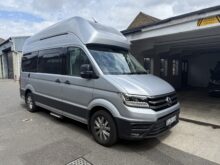
Striking: the completely redesigned front end of the California 6.1.
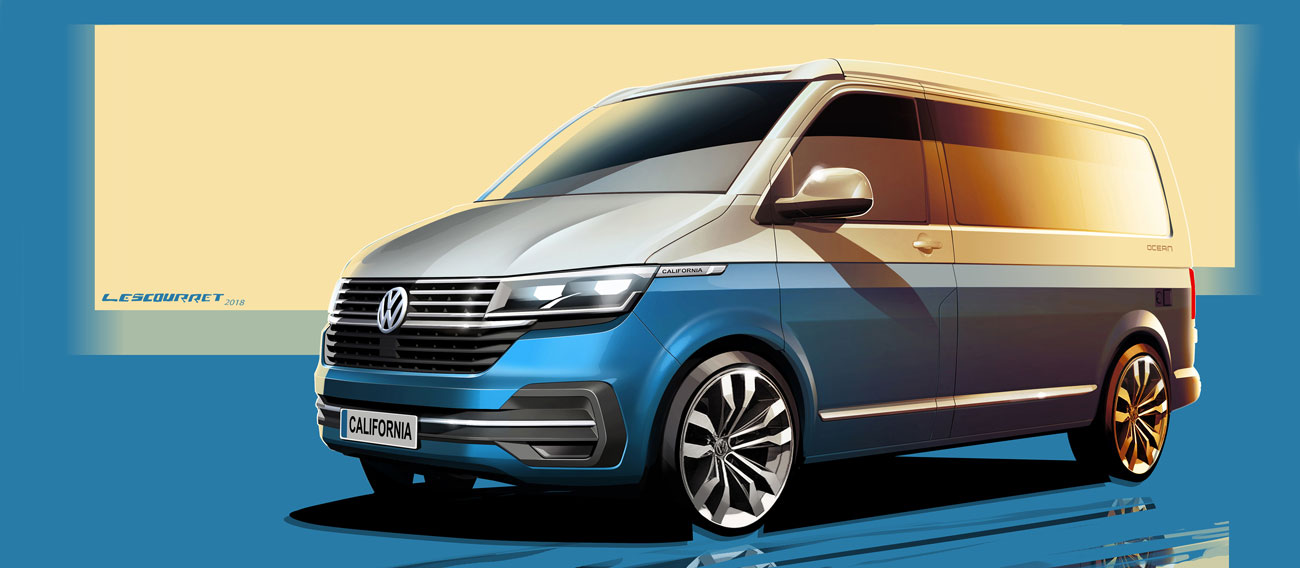
More than 18,000 Californias are sold per year making it the number 1 campervan and a true all-rounder, ideal for big trips and daily journeys. Now Volkswagen Commercial Vehicles has further refined the top seller.
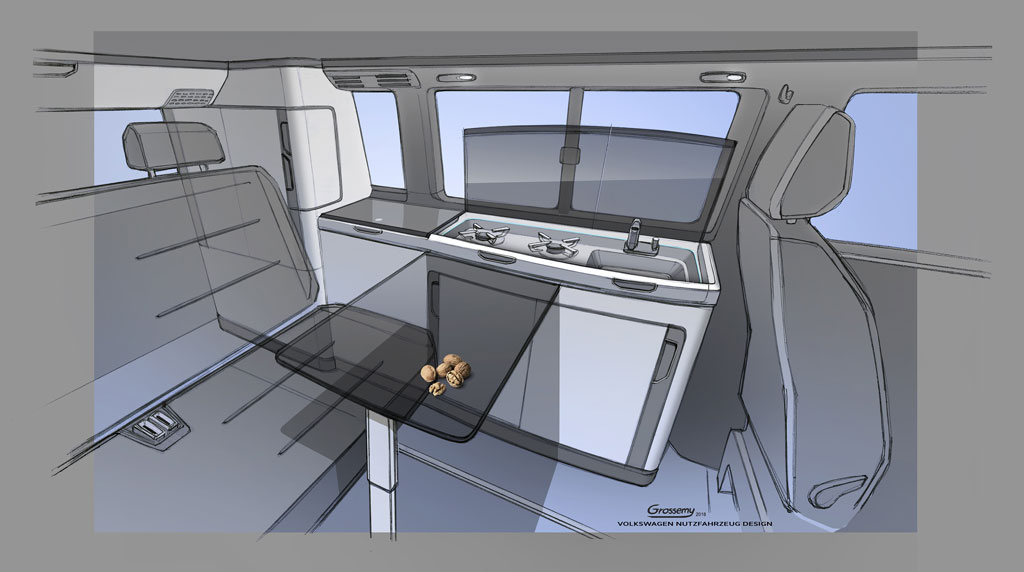
At first glance, the interior sketch above looks very similar to the current model, but there are a few subtle changes, like the addition of levers on the seats instead of the adjustable knob, plus a slight redesign of the unit, handles and sink tap. How these will translate to a production model is yet to be seen, but Volkswagen tell us that the living and sleeping areas have been carefully enhanced and optimised — we hold our breath in anticipation!
Furthermore, the driver and front passenger experience includes a redesigned dashboard that houses completely redesigned instruments (with optional digital dashboard for the first time) and new online infotainment systems.
Like the Multivan 6.1 revealed earlier this year, the California 6.1 features electromechanical power steering and Volkswagen Commercial Vehicles is also giving the camper numerous new assistance systems. for example “Lane Assist”, Side Protection and “Trailer Assist”, which makes light work of manoeuvring with a trailer. In addition, a side-wind compensation system makes travelling in the California 6.1 even safer.
The new California T6.1 will be launched with highly efficient 2.0-litre turbodiesel engines1 with output of up to 146 kW /199 PS. The new camper generation will celebrate its world premiere at the end of August at the Caravan-Salon in Düsseldorf. Other engine variants will be available for the commercial vans, but a little more about this later.

The latest edition of an icon
Volkswagen Commercial Vehicles has continually reinvented, further developed, sharpened and improved the blueprint for European transporters, large vans and caravans. This update is no exception. In integrating a new range of assistance and infotainment systems, the development team has delved deep into the technology. Dr Thomas Sedran, Chairman of the Management Board, Volkswagen Commercial Vehicles: “The new T6.1 is the car for the here and now. We have taken a proven vehicle and updated its assistance and infotainment systems and connectivity to the state-of-the-art today.”
New Cross Wind Assist included in the T6.1 as standard
“The hydraulic power steering of the T6 has given way to an electromechanical system in the T6.1 which enables active intervention into steering control. This changes everything, because it opens up access to new assistance systems”, according to Alexander Hitzinger, Board Member responsible for Technical Development. Hitzinger continues: “In the T6.1 we wanted to set new standards in vehicle safety, convenience and comfort. Especially important to us was driving stability. We have made significant progress here.” The new assistance systems include Cross Wind Assist – a standard system in all T6.1 models. When there are cross winds, it automatically stabilises the Bulli in case of strong wind gusts. This makes a noticeable contribution to safety.
New assistance systems steer and brake automatically
 Also on-board thanks to electromechanical power steering: the Lane Assist lane-keeping system. It detects road lane markings by camera and automatically keeps the T6.1 in its lane. From now on, Park Assist will simplify parking and reversing from parking spaces. When it is activated, the system automatically guides the vehicle in and out; all the driver needs to do is operate the accelerator and brake pedals. To ensure that everything goes right in manual manoeuvring, the side protection system from the Crafter was adapted for use in the T6.1. It utilises distributed ultrasonic sensors around the vehicle to reduce the risk of collision damage. Meanwhile, Rear Traffic Alert protects against accidents while reversing; the system warns the driver of vehicles approaching at a 90-degree angle behind the car. If the driver does not react, the system actively intervenes with braking.
Trailer Assist simplifies manoeuvring with a trailer
All models of the product line are ideal towing vehicles. Depending on the engine, the maximum trailer weight can range up to 2,500 kg. Now, Trailer Assist, familiar from the Crafter, makes it easier to manoeuvre with a trailer. It takes care of all the complicated rethinking when a driver manoeuvres in reverse with a trailer, i.e., having to turn the steering wheel to the left to get the trailer to turn right. The driver simply sets the desired reversing angle for the trailer using the rotary knob of the electric exterior mirror adjuster – which becomes a joystick – together with a display in the cockpit. Then the T6.1 takes over steering. Trailer Assist represents a fusion of Park Assist, electromechanical power steering and the Rear View reversing camera (which detects the articulation angle of the trailer draw bar). The range of new systems is supplemented by road sign display via the front camera.
Digitalised interior features new dash panel
 The dash panel of the T6.1 has been redesigned. Albert Kirzinger, Head of Design, Volkswagen Commercial Vehicles: “We have systematically tailored the driver’s workplace requirements to the digital world in the vehicle.” The team led by Kirzinger implemented the conditions needed to integrate the Digital Cockpit (fully digital instruments) and the third generation of the modular infotainment matrix (MIB3) in the T6.1. The fusion of the Digital Cockpit and the MIB3 creates a new digital landscape of displays and controls that is aligned along one visual axis.
Digital Cockpit has a 10.25-inch display
The 10.25-inch Digital Cockpit of the T6.1 sets new standards. It is included as standard in the Multivan Highline. The display’s high-contrast graphics have been designed for clarity and sophistication. The driver can choose between different screen configurations. They are switched by pressing the View button on the multifunction steering wheel. Configuration 1: a rev counter and speedometer are displayed interactively in the round instruments. An individually selectable content level is shown in the middle of the screen – such as the phone book of the smartphone. With the top infotainment system, the navigation map can also be opened in the middle between the two instrument dials. Configuration 2: available here is a digital view without dials that offers various information fields. Also integrated centrally here is a user-selectable display – e.g. the media library. The conventional analogue instruments were also redesigned; they feature a multifunction display located in the middle.
MIB3 offers displays up to 9.2 inches in size
Another highlight in the T6.1 are the new navigation systems of the MIB3: the Discover Media (8.0-inch) and the Discover Pro (9.2-inch). The graphic layouts of these touchscreen systems have been redesigned. Functions can be individually configured, like the apps on a smartphone, from a home screen that can be personalised. The display of the Discover Pro also features a full glass overlay. The infotainment programme is rounded out by MIB2 systems: the Composition Audio (with line display, standard from base model) and the Composition Colour (6.5-inch touchscreen, standard from Caravelle Highline, Multivan Comfortline and California Coast).
Infotainment systems with integrated SIM card
The most important new equipment feature of all infotainment systems is an integrated SIM card (eSIM). It is included as standard from the Composition Colour and is available as an option for the Composition Audio. The eSIM opens up a new range of online-based functions and services. An example is the eCall function. When an accident occurs, this system automatically sends the vehicle’s location to an emergency response centre and establishes a voice connection. If no response is received from the car, emergency services are informed. In addition, the eSIM represents the interface to “Volkswagen We” – a new world of online services. The 8.0-inch and 9.2-inch systems of the MIB3 also offer features such as internet radio and music streaming services.
Natural language control simplifies operation
Thanks to the eSIM, user control is even more intuitive and thereby easier. That is because the new 8-inch and 9.2-inch infotainment systems in the T6.1 can now react to natural language commands. The voice input is compared to an online database and is automatically translated into digital commands. As with other smart devices, all it takes to get the T6.1 to listen is a brief wakeup command. In this case: “Hey Bulli”. Then the conversation might continue like this: “I would like to go to the Gendarmenmarkt in Berlin.” And the navigation system quickly suggests the precise address as a new destination.
Apple CarPlay™ now operates wirelessly too
Another important interface is being perfected by MIB3: App Connect. Using this function, smartphone apps like Google Maps, the Media Library or Spotify can be used directly via the infotainment system’s display. Until now, a cable connection was needed between the smartphone and the vehicle. For iPhone users, this cable is now “history” in conjunction with the 8.0-inch and 9.2-inch systems.
Once an iPhone has been coupled, it will automatically connect with the infotainment system via Bluetooth and the wireless Apple CarPlay™. Compatible smartphones of all brands can now also be charged wirelessly – via an inductive charging station in the new dash panel.
New front-end design of the product line
If there is any van whose design can be considered “perfect” just as it is, then it is the T6. Even more: for many fans of the versatile vehicle, the design has long acquired a huge fan base. The team led by the Head of Design, Albert Kirzinger, has therefore intentionally sharpened just the front end. Kirzinger: “The T6.1 has even greater presence on the road. We now have a very large air intake – which is something we really need technically with today’s engines. At the same time, we were able to emphasise the vehicle’s width and develop an even sharper look.” The crossbar formed by the more compact design of the headlights and the upper part of the radiator grille is narrower than in the previous model. “In this area, we have designed a new double chrome bar which extends across the entire width and into the headlights as LED strips for the daytime running lights. The car expresses a very special charisma and can be recognised as a T6.1 from a long distance.” The front end may also be personalised with more chrome details depending on the model and equipment. The ranges of colours and wheels have also been remixed.
Power outputs of Euro-6d-TEMP engines range from 90 to 199 PS
While many of the T6.1 engines will not be available on the California, it is still worth mentioning that the engine programme has been reconfigured across the Transporter range, including the introduction of a zero-emission vehicle based on a partnership with ABT. With an output of 82 kW / 112 PS and a battery capacity of either 38.8 kWh or 77.6 kWh, driving ranges of more than 400 km (NEDC) will be possible — whether this will eventually make it to the California lineup is yet to be seen, but for now a 400km range will not be useful to those of us who enjoy those epic California road trips.
The California 6.1 in a nutshell…
- New and more comfortable: enhanced interior and new display for the camper functions
- New and connected: digital cockpit and online infotainment systems with integrated eSIM for the first time
- New and sharper: front end with charismatic design transports the DNA of the California to the future
- New and safe: side-wind compensation system, “Lane Assist” and Side Protection for extra safety
Stay tuned for more details as they are announced!
USED VANS FOR SALE
ACCESSORIES MARKET
CAMPERVAN HIRE



Classifieds

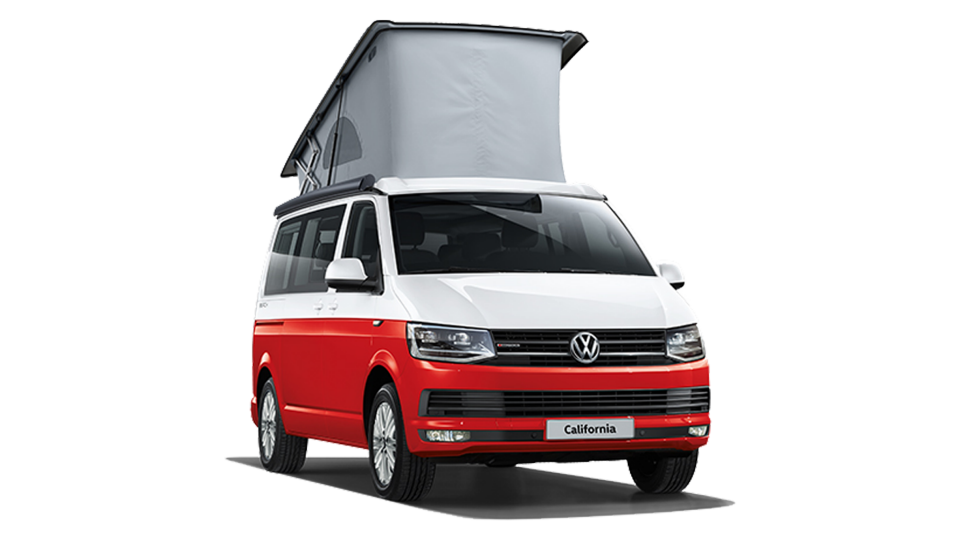




 No matter how much we love our Volkswagen Californias, one day it will be time to say goodbye.

 Before you sell your Volkswagen California you should really have a valid MOT Certificate — obviously this only applies to vehicles over three years old, but any older vehicles without a valid MOT will certainly raise eyebrows and drastically reduce the chance of a sale. This will also potentially limit your market to dealers who will take advantage of the unverifiable state of repair.
 As with selling any vehicle, you will need to complete the details of the new keeper and post this to the DVLA as soon as you can. The DVLA recommends not to buy any vehicle if the V5C isn’t available, so if you have lost it, it is important to apply for a replacement rather than expecting the new owner to do so.
 Our
Our 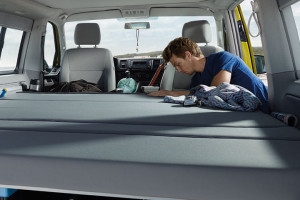 Treat with extreme caution any offer to buy the van without seeing it first or anyone who asks you to meet them in an unusual location or wants to have a courier collect it. These are common signs of a scam and not worth the risks involved.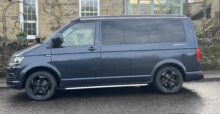
 This amazing offer is running from now until Thursday the 18th April 2019 and promises to offer peace of mind before you motor off on your Spring Holliday!
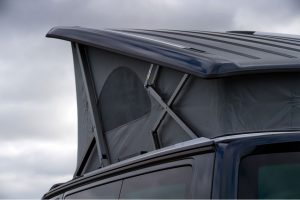 Check that the roof is in alignment when raised, and look for any signs of damage on the canvas, especially behind the metal “scissor” mechanism at the rear sides of the pop top.
 Check the electric hook-up point. Check that the flap opens and closes and there is no damage to the connection or panel – for example by driving off while connected to the mains (there is a warning alarm should you accidentally do this). If you get the chance to connect it up, the overhead control panel (above the cab) will tell you whether the hook up is charging the batter by displaying a two pronged – continental plug symbol bottom right. Incidentally a ‘G’ symbol means charging when you are driving.
 Check that the fridge works – it is probably a good idea to turn it on when you arrive to ensure it has cooled down by the time you have looked around everything. The overhead display will indicate that the fridge is working by means of an illuminated snowflake icon
 Operating the independent rear heating is done from the heads up control panel in much the same way as the fridge; there is an icon on the overhead display that illuminates when operational. The warm air is blown from a vent on the door column. There will be a slight smell of diesel on startup, but after this make sure there are no ongoing fumes in the vehicle and that the air is hot. Check that the remote fob to operate the heating is present and works.
 The armrests on the driver and passenger seats should be checked in case someone has stood on them to get into the top bed.
 Drop the headrests back via the button and ensure the pull-strap is not damaged. We would suggest if the vehicle does not have a sleep pack or mattress topper that you invest in one to give a more comfortable night.
 The privacy screens are nearly all different depending on the part of the van and the model year. Pull down all blinds to make sure they all stay down – it’s easy to miss if you don’t know where it is, but there is a small sideways running blind for the window next to the wardrobe. On UK T5 and Beach models, there is a pack of 3 blinds that covers the windscreen and front side windows, it should have a front blind and driver and passenger blind. On the T6 Ocean and older European models the windscreen has a built in blind that extends over the dashboard, and as such the pack will only contain blinds for the front side windows. Pay special attention to the blind above the sliding door as it can become accidentally bent from people climbing in and out and bashing their heads. Operate all windows to ensure they all open and close correctly – the rear windows operate by pinching the middle catch together.
 Check this moves freely, the leg is secure, look underneath especially at the rivets to ensure no weight has been applied to the table.
 In the tailgate there is a zipped compartment for stowing chairs. Check this holder that the chairs are there; check the zips and rings that hold the seats in place. Take the deck chairs out and open them and check for wear and make sure that all the bolts are in place and tight – these do work loose and so we recommend you tighten every once in a while.
 See that everything winds out and in reasonably smoothly and that the legs lock into position. Check that the tent pegs are still in place, but if not they can be replaced relatively cheaply.
 Chances are that there will be a degree of wear and tear around the boot area – make sure that this is at an acceptable level. Check that the parcel shelf / bed frame can be removed and moved up to or down to the next level as the fixtures for this can suffer a few knocks.
 There really is no reason to buy a T5 or T6 California without a full service history. People love these vans and tend to keep them serviced and looked after for many years. If there are missing stamps in the book then this may be evidence of neglect at some point.